Taking Our Story Home

India, Jodhpur, Literature, Mehrangarh Fort, Music, Stories, Storytelling, Travel, Women

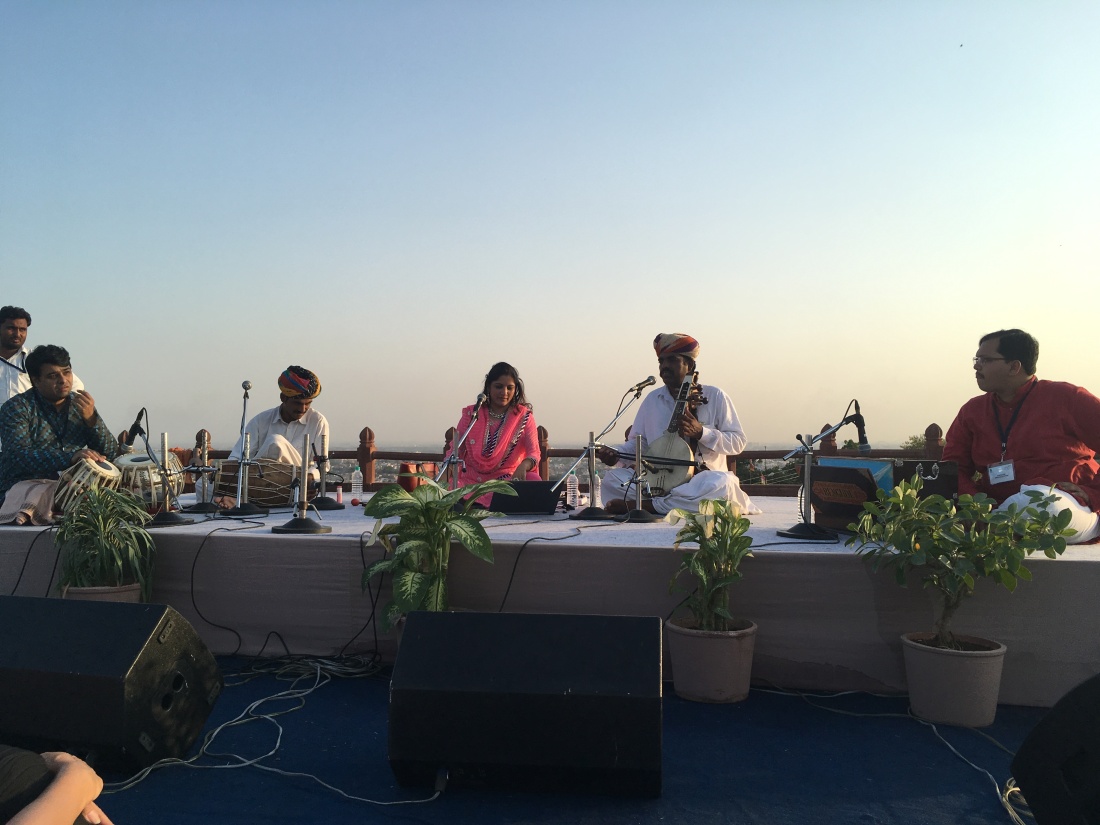
Hands of Time, a story and music collaboration weaving histories and tales from Wales and Rajasthan was premiered at BtB earlier this summer, despite almost half our creative team being missing due to visa difficulties. Nevertheless, the show went on, and then transferred to Festival of the Voice in Cardiff. Last Saturday night, we took the story home to Mehrangarh Fort where so much of it is set, and performed to a packed out audience of some 400 people in the beautiful courtyard gardens of the Fort. What began as a creative collaboration became a profound communal ritual of re-membering forgotten souls and re-weaving a ragged patch of Mehrangarh’s history. The very walls of the fort listened, and I sense the standing ovation we received was as much for the lost stories we honoured as it was for our performance.
3e766ff8-b1dd-4737-85ca-a251517873fe

The Hands of Time team at Beyond the Border, July 2018. Left to right: Divya Bhatia, Angharad Wynne, Manjeet Rasiya, Smita Bellur, Gwilym Morus-Baird and Dara Khan Manganiyar

This Wales-India odyssey began four years ago.  Supported and indeed encouraged by Wales Arts International, David Ambrose and I began a journey to develop a creative storytelling partnership between Beyond the Border Festival and Indian artists. A year later, we met Divya Bhatia, Artistic Director of Jodhpur Riff (Rajasthan International Folk Festival – JRiff), and a creative partnership between our festivals began.

On my first visit to JRiff at Mehrangarh Fort, the huge, red sandstone fort that sits like a brooding hunting hawk, overlooking the desert city of Jodhpur, I was intrigued by vermillion plaques depicting hands, placed at some of the fort’s seven great gates. I watched as women in jewel coloured saris pressed palms and foreheads to these plaques and kept them adorned with garlands and tinsel decorations. I asked one of these women about the hand marks, and she replied simply “They are hands of Sati.”

IMG_0165

31 Sati hands on the left hand side of Loahpol gate, as you enter Mehrangarh Palace

That first visit was part of a research trip to build a creative partnership between BtB and JRiff, which is held annually during the full moon of October. During that first visit, I learned that ‘Sati’ were women who immolated themselves on their husband’s funeral pyre, or in the case of the Sati of Mehrangarh, women of the zanana or harem of the maharajas as well as their rani ~ queen. This ancient practice dating back to at least 3rd century BCE in the region was outlawed by the British in India in 1861, however, rare instances continue to be reported. Some consider it a decision based on honour, others consider it to be a mark of deep, abiding love, but clearly in some cases it was about coercion too.

IMG_7435

One of the 200 or so letters sent by Thomas Gruffydd to his family.                                                       In the National Library of Wales’ Garn Archive.

The creative process is an extraordinary thing. I’ve learned that casting the net wide during the research phase works best for me, and simply to be open to what is caught in it. The first silver fish in the net was a Welsh nabob called Thomas Gruffydd, the third son of Jane and John Wynn Gruffydd of Garn estate in Denbighshire. He left Wales at just 15 years of age to join the 20thBengal Native Infantry, in the pay of the East India Company. All that is left of his 27 years on this earth are some 200 letters he sent home to his parents, siblings and grandmother, kept in the archives of the National Library of Wales. Other intriguing silver sprats caught the net included two stories gifted to me by storytellers in the desert villages on the far west of Rajasthan bordering on Pakistan, that I met with interpreters during a research trip to the region last year as we built the project. These weren’t easy stories to tell in the version I’d heard, but I worked with them to try to tease out a telling.

IMG_4710

Meeting with traditional Rajasthani Storytellers in desert villages on the border with Pakistan in October 2017

While I was working on these, the shades of the Sati of Mehrangarh were powerfully present in my thoughts. They tugged at me, demanding my attention. And so I dug deeper and contacted the Fort’s archivists. We batted emails back and forth and spoke over a couple of phone calls. What became clear very quickly, was that only the names of the ranis of the maharajas of Marwar (for whom Mehrangarh was one of their most important seats of power), were recorded by history. There are a few exceptions, in cases where the women of the zanana produced sons who became particularly powerful in some way. But other than that, the thousands of royal courtesans housed in the Palace of Glimpses at Mehrangarh had left no trace, other than those who committed sati.

The archival team were able to tell me more about the rituals surrounding Sati, and some preparations particular to those of the women of the Fort. The women of the zanana preparing to immolate themselves on the Maharaja’s pyre would don a red bridal sari, apply henna on their palms and while passing through the Zenani Deodi (Ladies Passage/Gate) would dip their palms in a platter full of henna-kumkum paste and make a handprint on the entrance of the gate wall. Earlier these handprints had been made on paper, wood, stone and silver slabs – sometimes later carved by the silversmiths, and placed in the royal temple at the Fort, alongside the shrine to the Goddess Nagnechiya, to be worshipped.

In time this tradition moved to the walls of the gates; this was first done during Maharaja Bakhat Singhji’s reign where handprints were pressed to the sidewalls of the Lohapol gate.  On the left wall of Lohapol there are five Sati Handprints. Four are of the concubines and one is that of the queen of Maharaja Man Singh (1803-1843) who became Sati after his death.

I was moved by the thought of thousands of women who had spent their lives kept excluded from the world, most leaving no mark upon it, others leaving only their hand-print and their memories in the Fort’s walls before committing Sati. There are some 100 sati hands in and around Mehrangarh, none of their stories are remembered or told. As mentioned, I knew that five were the Sati of Maharaja Man Singh, the last independent Maharaja of the Kingdom of Marwar, who entered a treaty relationship with the British in January 1818. These dates tallied with Thomas Gruffydd’s time in India – just about. A story was gathering.

I wanted to create a story for one of the Sati of Mehrangarh. Re-member just one of these women to honour all those forgotten souls of the Palace of Glimpses– a story to honour their memory and give form and flesh to the gaping wound of anonymity. And from somewhere, somehow, Heera emerged from leagues of dust, desert and time. My work was simply to use knowledge and research to apply checks and balances to a character that manifested fully formed – almost too real, too vibrant and full of her own story to simply be a product of my imagination. Writers and creators the world over experience this, each culture has its own way of explaining it. For me, I know that I gave Heera her name – I chose it. It means ‘diamond’. The rest I cannot in all conscience claim….it is simply ‘her’.

IMG_9877

Hands of the five women of Maharaja Man Sing’s court who immolated themselves on his funeral pyre in 1843. One of these was his queen. The names of the four others are lost to history. Located on the right side of Loahpol gate as you enter Mehrangarh palace.

Weaving Heera, Thomas and Man Sing’s story with the lush green, grey misted threads of Wales and the pale, sun soaked, jewel coloured threads of Rajasthan has been one of the keenest creative joys of my life. Moreover it has taught me a good deal and felt like a profound act of reclaiming something lost. It has been a privilidge to cradle the fragile fabric of their lives in my hands. I know that their story has moved audiences, and deeply touched the wonderful team of musicians I worked with on this project – Gwilym Morus-Baird, Smita Bellur, Dara Khan Manganiyar and Sawai Khan Manganiyar.

C56663AB-AA5F-48A9-A83E-7739B0BBC8AB

The Hands of Time family ready to perform during JRiff on 26th October at Chokhelao Bagh, Mehrangarh Fort. From left to right: Sawai Khan Manganiyar (dholak & vocals), Dara Khan Manganiyar (Kamaicha & vocals), Angharad Wynne (storyteller), Smita Bellur (vocals) and Gwilym Morus-Baird (guitar and vocals).

Last Saturday night as some 400 people settled to listen to us share Thomas and Heera’s story in Chokhelao Bagh, the Garden’s within Mehrangarh, there was an intense sense of listening, as though the very shadows and even the walls of the Fort were craning to hear the story unfold. Swallows feature a lot in it, and they swooped by the dozen diving around me as the sun set and the story commenced, before eventually retreating at dusk to their clay nests beneath the high arches of the fortress’ seven great gates.

My belief is that beyond simply telling the story, we re-membered something important that evening, and in so doing, healed a little of the ‘forgetting’, patched a few frayed pieces of the web of history and helped those like Thomas and Heera live beyond the fine, short threads of their lives.

In profound moments of life, I find that the universe speaks eloquently through synchronicity . Following the performance many people came up to us, wiping tears from their eyes to thank and congratulate us or ask questions. One mother and her daughter approached me. The mother said “I’m wearing a Rabari embroidered dress.” I looked at and admired the beautiful hand stitched designs that overlaid the silk and cotton of her kurta. I had described such stitching on Heera’s black dress and coloured Rabari chunari. Then I turned to her daughter. What they hadn’t noticed, was that the black fabric of her more western styled dress was covered in small, fork tailed swallows. It was veritable villanelle of synchronicity, and felt significant in some unfathomable way.

Stories are powerful things. They are used for healing by many cultures, used as ritual tools and as incantations to re-member the ancients. They are ways of communicating with the gods as much as with each other. On this Calan Gaeaf or Haloween, as we light the jack-o-lanters, let’s remember to tell the stories of our ancestors. That is, essentially what this festival is about: remembering ancestors, telling their stories and honouring them in that re-membering, because while we are remembered, we are never truly dead.
Meeting Saraswati in the Desert

Culture, India, Music, Stories, Storytelling, Travel, Women

We arrived in the village of Tallo ki Dhani at dusk, our car having scrambled and struggled across sandy dessert tracks for a few miles beyond the shingle road. Some of the men of the community and a posse of children gathered round our car. They smiled shyly, though I expected that curiosity would soon win out. After some introductions and sharing sweets with the children, the Shoogles were taken to the house, where musicians with whom they’d collaborated were waiting to welcome them.

IMG_4708

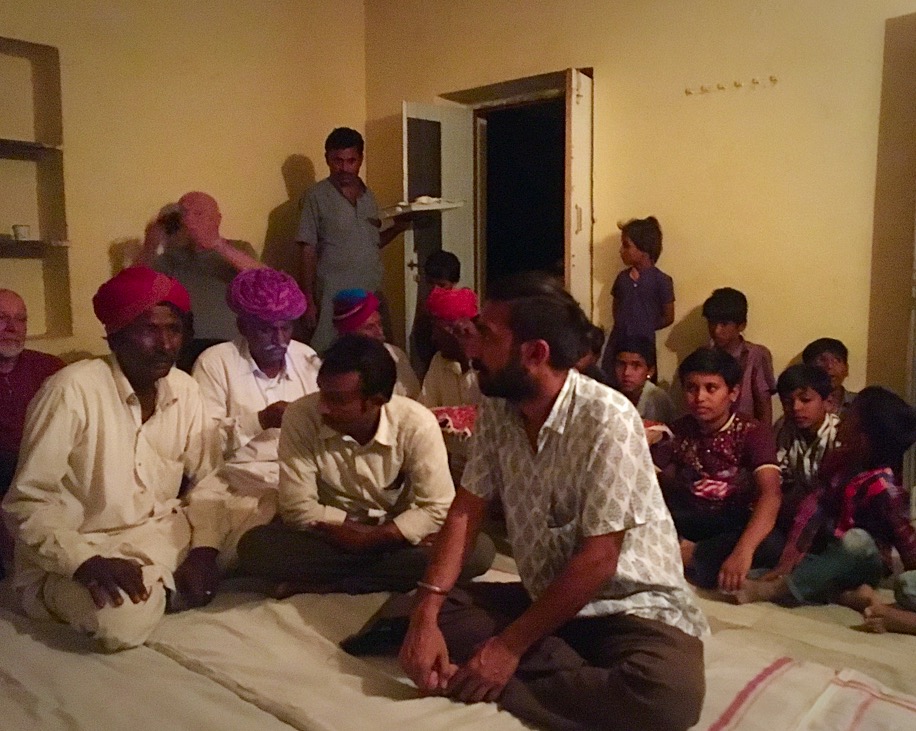
Gathering in the ‘village hall’

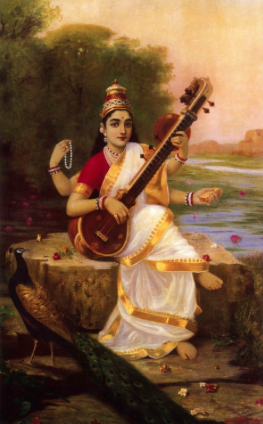
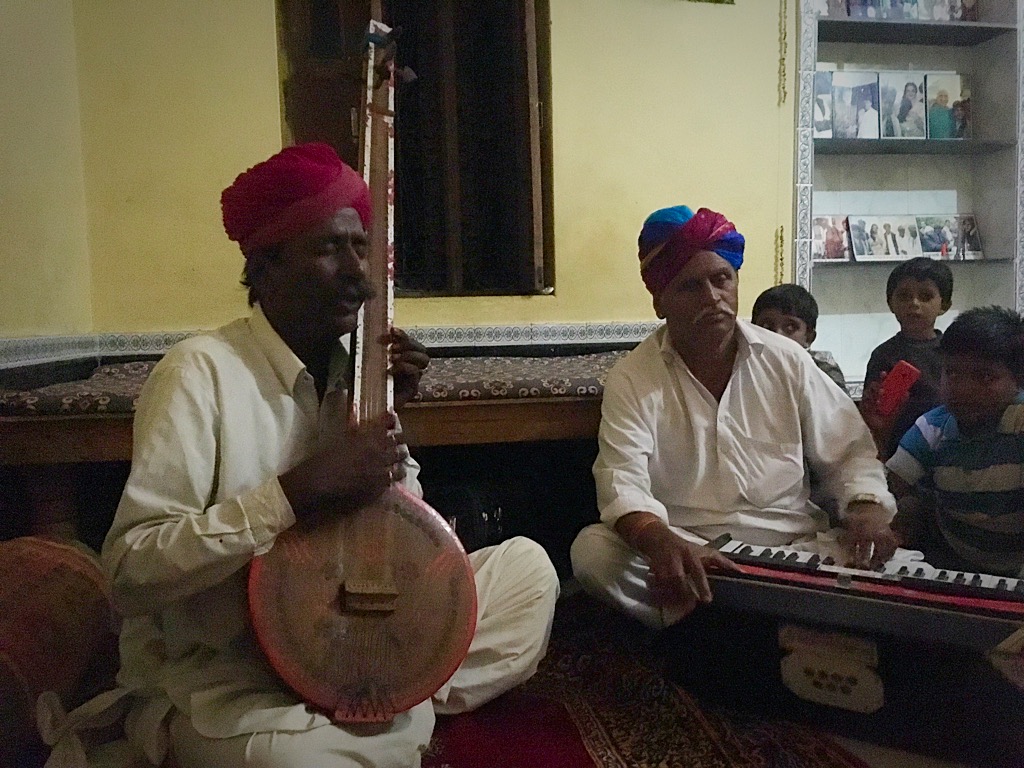
Gwilym, Govind, our guide and interpreter and I were ushered to what was described to me as the village hall. This squat, concrete room gradually filled with storytellers and their attendant musicians that had come from two different villages (those we had failed to visit that day due to the delay in gaining our permits), and some twelve curious boys and three young girls who stared wide eyed at Gwilym and I between fleeting glances at Bhaga Khan who was quietly tuning his tandura, a long necked fretless Indian lute, with a body made from a gourd. It is the chosen instrument of Saraswati the Hindu goddess of knowledge, music, arts, wisdom and learning worshipped throughout Nepal and India. In most images and statues she is depicted either playing the tandura or holding one.


IMG_4709

Bhaga Khan singing a story with his tandura


Every so often, one of the men would hush fidgety children, or impatiently shoo them out of the room, but gradually, their faces would re-appear at the window and at the door and they would slink back in like young foxes, drawn to the storyteller. His head was bent to the neck of his instrument, his eyes closed, totally absorbed in the act of adjusting the tone of four metal strings, as though nothing else existed in this world but the sound and the tuning pegs. We all watched him, drawn in by his focus and the air of peace about him.

Govind filled the waiting, explaining that Bhaga Khan, had spent time living with sadhus, Hindu ascetics who had renounced worldly life. He’d learned from them many devotional and teaching stories, which he now told in addition to the traditional Manganyiar storytelling repertoire. A few minutes later as the final tuning was done, and the dholak player finished tapping the edges of his hand drum to tighten the goat-skin, the room hushed and Bhaga Khan began. Head still tilted intimately to the tandura, he strummed a drone then began to sing in a light, gentle voice, lines of an ancient song he’d learned from a sadhu called Gee Aram in Varanasi. In this form of storytelling performance, songs are used to punctuate portions of story narrative. The songs use lines of ancient and often difficult to decipher spiritual poetry, and any number of tales can be partnered with each song, they are matched only by theme or the lesson they communicate.

The story he chose to tell was of a boy child waiting impatiently in the womb to be born. Of the prayer he makes to Param Atma or Great Spirit, promising always to remember him, to live a good, purposeful life, rich in bhakti, the Hindu practice of emotional devotionalism, particularly to a personal god or to spiritual idea.

The child is born and grows in this world but forgets his promise and his connection to Param Atma. He wastes his gifts and lives carelessly. As a result, he is burdened by guilt, anger and sorrow. The song-story ended with an entreaty for us all to lay down our fire, our anger and sorrow and return to the true path of our lives, and remember our birth promise to Param Atma.

The second story he told was of the Pandava brothers, Yudhishthira, Bhima, Arjuna, Nakula and Sahadeva from the Mahabharata. The time of the five brothers on this earth was coming to an end. As Bhaga Khan explained it, their time, or to give it the Hindu name yuga –was ending, and a new yuga was beginning. He stopped strumming to explain that there are four yugas in a cycle:

  • Satya Yuga – the age of truth and perfection when there was but one religion, and all men were saintly. Humans were gigantic, powerfully built, honest, youthful, vigorous and virtuous. There was no disease or fear of anything.
  • Treta Yuga – in this age, virtue diminished slightly. Many emperors rose to dominance and conquered various parts of the world. Wars become frequent and weather began to change to extremities. Oceans and deserts were formed and agriculture, labour and mining began.
  • Dvapara Yuga – in this age, people became tainted with base qualities and weren’t as strong as their ancestors. Diseases became rampant and humans became discontent and so began to fight each other.
  • Kali Yuga – the final age of the cycle, through which we are said to be living now. During this time, people lack virtue, they become slaves to their passions and society crumbles, knowledge is lost and scriptures are diminished. Humans eat forbidden and dirty food. The environment is polluted, water and food become scarce. Families become non-existent. By the end of Kali Yuga the average lifespan of humans will be as low as 70 years.

Bhaga Khan started to strum once more, and the tale of the Pandava brothers began to weave as Govind translated the story for us in sections. In short, he told a story from the end of the brothers’ lives. After many battles and adventures, the Pandava brothers and their wife Draupadi managed to rule Hastinapur for 36 years and established a righteous kingdom. Shortly after the death of Lord Krishna, they all decided that the time had come for them to renounce the world, as the age of Kali yuga had begun.

Screen Shot 2017-10-31 at 22.39.58

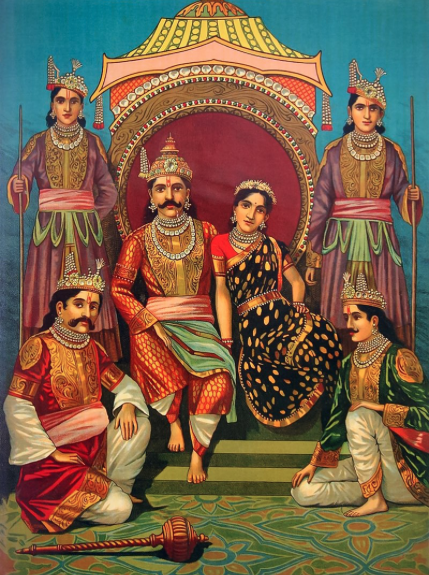
The Five Pandava brothers and their wife, Draupadi

So the five Pandavas and Draupadi leave Hastinapur to follow the path of liberation. They renounce the world and their possessions and set off to climb Mount Kailash, which leads to Swarga Loka, one of the eight higher spiritual planes in Hindu cosmology.

One particularly memorable section of the song-story describes the poignant farewells of the brothers’ with friends and neighbours.

Along on their way, all except Yudhisthira die. Yudhisthira is the only one to reach the door of Swarga Loka. He is accompanied by a dog, who is none other than Lord Yama, the lord of death and spirit himself. The story ends with the message that though the Pandavas may have departed this world, the tales of their good deeds remain and so, they are never truly gone nor forgotten.

All too soon, the story was ended, and for a while we sat and discussed the many similarities in stories across the world, and the wisdom teachings and truths held within the tales we tell. There was something sacred about his telling and I could have listened to Bhaga Khan all night long, but the women of the village had been cooking and it was time for us to receive their hospitality. I walked with Bhaga Khan into the darkness beyond the ‘village hall’, thanking him for the stories, giving him a kilo of hand made confectionary – which seemed a poor exchange for the riches of his telling – and sharing hopes that we would meet again to share stories next year.

I carried the stories and songs with me, as Gwilym and I were led to the open central courtyard of a family dwelling, flanked by four squat, single story mud built houses (our equivalent of cob built dwellings) with thatched roofs. A rug was laid out on the hardened earth floor of the yard for us to sit. Govind and Sharon our wonderful guides and translators joined us and we were served with small dishes of home-grown, home cooked spiced vegetable delights and millet roti straight from the clay oven. It was delicious. Rice is a scarce and expensive grain for these desert communities, but with visitors coming, they’d invested in a bag to make us a special desert, traditionally made for festivals and special occasions, which I’ve come to love, chawal ki kheer. It’s like a rice pudding but infused with cardamom, saffron, sugar, sometimes rosewater and other spices too. At the time of Sharad Purnima (the October full moon in India, which is the brightest and which had just passed), the rice is often left out beneath the light of the moon for up to three days to absorb its energy before the pudding is made.

The men of the family joined us, while the women prepared and served the food. Every so often, a half-clad toddler would make a dash for his father’s lap before being shooed away by one of the men, and we’d all laugh.

At the end of the meal, through Sharon, I asked to meet the women of the family who had prepared our food. This being ‘women’s business’ we were ushered into one of the dwellings where our host’s wife, her mother in law and sister in law greeted us, and where through Sharon, we were able to thank them for the meal and talk a little.

They were as curious about me as I was about them, but their questions overwhelmed mine. They asked if I was married and whether I had children. I expected my answer to raise eyebrows in this very traditional village. I told them I had one daughter of fourteen. This only served to raise more questions. “Only one child?”

How does one give adequate reasons for the breakdown of a marriage to women for whom marriage for life is an unquestioned fact of being as much as is breathing. I explained that my daughter’s father and I had ended our marriage when she was young. Which only provoked another question – “Why?”

Across a dinner party table back home in Wales, this question might have seemed rudely intrusive, but there was such guileless honesty and concern in the young woman’s question that I found myself struggling to form an answer. In that moment, western sensibilities seemed somewhat feeble, but I explained as succinctly as I could some of the reasons why the marriage ended.

She took my hand and spoke softly. “Aren’t you lonely?” translated Sharon.

“No, not really. I have a partner.” I explained. The word ‘partner’ seemed to require quite a bit of explanation from Sharon. The young woman looked back directly at me with a slightly quizzical look in her eye, and responded.

Sharon translated.“She’s asking if this is usual where you come from.”

How to answer that one? “No” I said. “It’s not usual, but it’s not unusual either.”

Sharon related my answer and the young woman’s gaze returned to mine. She shrugged her shoulders, a gesture that is universal it seems. She spoke again and Sharon translated. “She says it’s not usual here. Women marry at about sixteen and that’s it for life, but she understands that not all places are like this, that other places have different traditions, and that if this is usual in your country and you’re happy, that’s good.”

The young woman before me was in her very early twenties. She had a small son and an eight-month old daughter. She would have met her husband on her wedding day and had likely never travelled beyond 50 Km of the village. Yet, she was wise beyond her years, open hearted, generous, curious and accommodating of the fact that there were cultural differences across the world, and content for it to be so.

We steered our conversation to matters we had in common, first children and then to clothes. She disappeared, leaving me with her chubby eight month old in my arms. Sharon sidled up and reminded me that babies don’t wear nappies here. I didn’t mind, she was a bonny child, and I was missing my own daughter. Our hostess returned with her mother in law, carrying two lovely sari headscarves, hand embellished by the women of the family, and generously presented one each to myself and Sharon. She and her mother in law had great fun dressing us and we delighted and giggled at the results before the men were called and obligatory photos were taken.

It was a wondrous night. I had met Saraswati in the desert – twice! First I had encountered the artistic, creative aspect of the goddess in Bhaga Khan’s devotion to his art and audience. Then, I had found the goddess’ wisdom in in my young hostess, an understanding and acceptance far beyond her years and life experience.

Screen Shot 2017-10-31 at 22.52.32

Saraswati

Saraswati is a part of the trinity of Goddesses: Saraswati, Lakshmi and Parvati, who help the trinity of Brahma, Vishnu and Shiva to create, maintain and regenerate-recycle the Universe respectively. If we are in the Kali Yurga epoch of mankind as Hindus suggest, then it is this kind of open heartedness: sharing of knowledge and creativity, quiet wisdom and acceptance of ‘other,’ and a willingness to reach beyond and to find common ground so that we may celebrate that which makes us human, that might yet be the saving grace of our time.


Communicating Coherently

Culture, India, Music, Travel

This is a guest post by Gwilym Morus

Bringing together the music of Wales and India was always going to be a challenge, but as at it turns out, not in the way I expected. Before beginning on this project, I assumed the main issue would be getting to grips with each other’s distinct time signatures, modes and keys. But that wasn’t it at all; far from it.

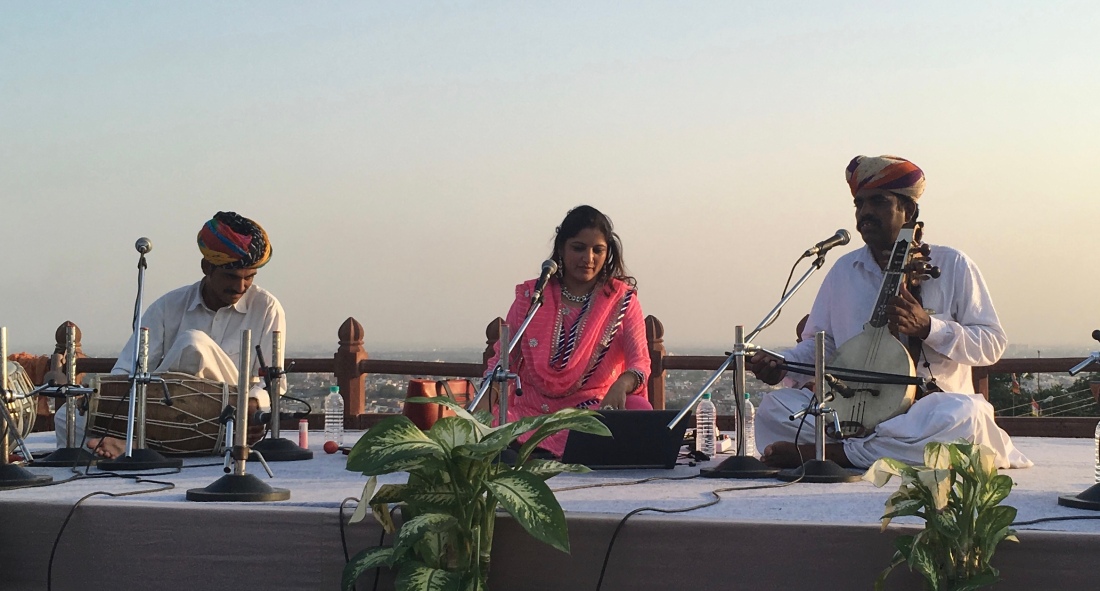
To be precise, our project is actually bringing together three types of music: traditional Rajasthani folk music provided by Darra Khan and Sawai Khan, Indian classical music provided by Smita Bellur, and contemporary Welsh folk music provided by yours truly.

The folk music traditions of Rajasthan are built upon the same basic principles as Indian classical music. Both are essentially based on raga, or rag as the Rajasthani musicians call them. I won’t try and describe what a raga is here, only that it provides a sophisticated melodic framework for a musician to improvise within. It’s also in that key feature of improvisation that our greatest challenge lies as a collaborative project.

Version 2

Our musical collaborations: traditional Rajasthani folk musicians Darra and Sawai Khan, and Indian classical singer, Smita Bellur. 

I grew up singing. Some of my earliest memories are of singing traditional folk songs with my mother. Then from primary school all the way through to the sixth form, I sang in several school choirs, even a few good ones. I went on to compose and perform music throughout my adult life. As a result I’ve often improvised music. In fact, as far as I can tell, all song writing begins with improvisation; how could it not?

For all of my years making music, never before have I come across a style of improvisation that has such coherence.

But for all of my years making music, never before have I come across a style of improvisation that has such coherence. That’s really the only word for it, coherence: a way of improvising melodies that make a lot of musical sense. Both Rajasthani folk and Indian classical traditions can give a musician the ability to improvise lines of music that are complete, finished and coherent within themselves, like a well crafted sentence or line of poetry.

This is different to the free flowing, stream of consciousness stuff that we hear so often in modern jazz music. Neither is it the tentative grasping for a half realised melody that I often experience in song writing. At the drop of a hat, Smita, Darra and Sawai can produce long lines of elegant, complete, finished and (I’m going to say it again) coherent melodies.

Version 2

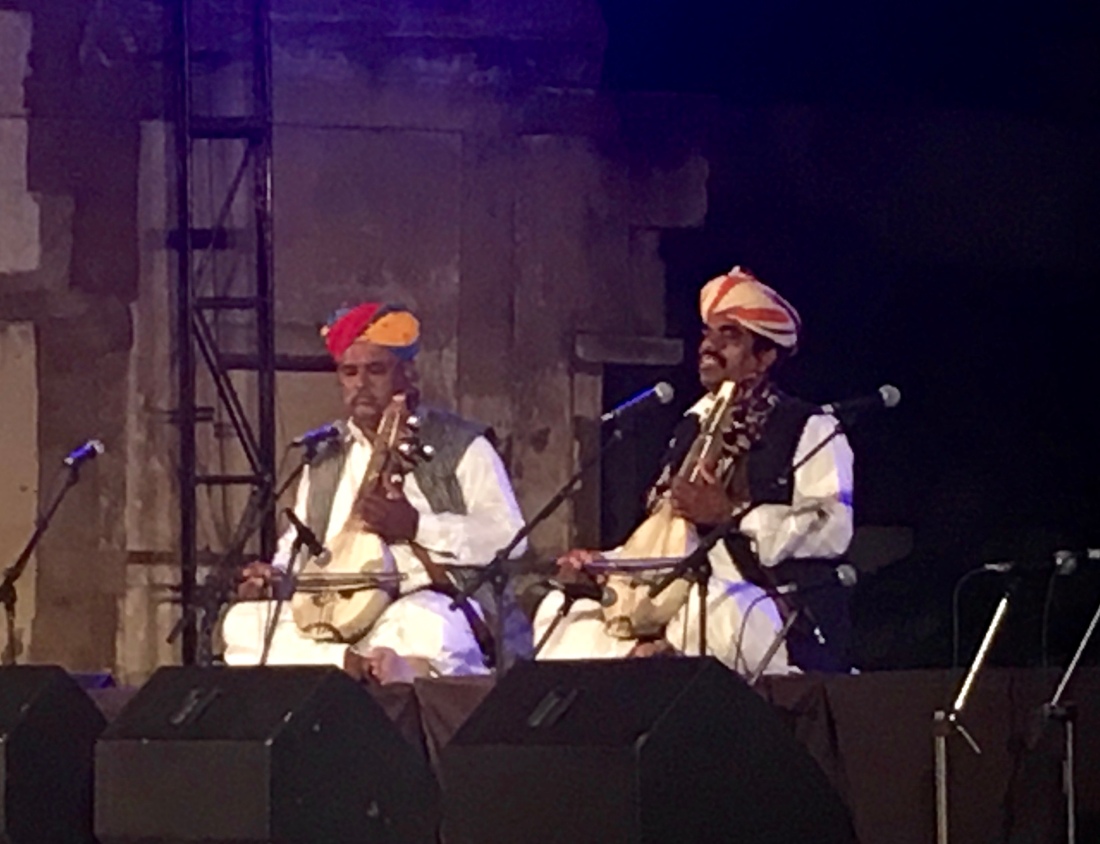
Kamaicha masters of their generation, Gevar and Darra Khan Manganiyar.

Of course, within these melodies, the particular raga they’re working in provides set notes and motifs that can be returned to over and over, but these sound like punctuation to me, defining beginnings and endings to continually evolving improvisations.

So what is the challenge? The Western musical tradition has largely evolved as a tradition of composers. The music of European cultures, for all its incredible ingenuity and beauty, is composed before performance, not during it. That means that musicians like myself have been schooled since childhood in viewing music as something pre-prepared, fixed, generally not improvised. It’s something we already know before we get up on the stage.

As a result, the biggest challenge I face over the coming months as I try and prepare music for our next collaborative stint, is ensuring that my addiction to that musical certainty, my need to know what comes next, does not impinge on the virtuosic flow of my Indian collaborators.

Screen Shot 2017-10-24 at 16.55.01

Ganesha’s Exchange: songs & stories for signitures & stamps

India, Music, Stories, Storytelling, Travel

It was time to pack up and say goodbye to Smita, Darra and Sawai until next June when they’ll travel to Wales to prepare for our performances at Beyond the Border and Cardiff’s Festival of the Voice.

Gwilym and I headed for the colourful riot of Jodhpur market in search of spices before meeting up with Govind and Sharon from the JRIFF team who would be our guides and translators as we headed out into Rajasthan’s desert communities to meet with more traditional storytellers, and learn about their traditions and the tales they tell.

IMG_4652

The delicious colours and dazzling flavours of Jodhpur Market

Scottish band Shooglenifty, who’d been recording an album with Marwar musicians as well as performing at JRIFF, joined us for the first leg of our journey. They were going to visit the villages and homes of some of the artists with whom they’d collaborated over the years, and fortuitously these villages were in the same region as those we would visit. So, on Monday afternoon, a large car and a minibus headed out of Jodhpur, west towards the setting sun on a four-hour drive into the desert region near Barmer.

IMG_4654

Roadside services – desert style. Chai with the Shoogles.

The next morning, we headed off early into the nearby town to buy a kilo of handmade confectionary to take to each village as a gift, and to pick up our permit letters. It all sounded straightforward, but administration in India rarely is. With three kilos of sweets in the back of our car, we headed for the local government office. We would be travelling into highly sensitive, militarised territory on the border with Pakistan. To obtain permits to visit the region, we’d already passed through stringent CIA checks and sent off a file full of official documents, so all that was now technically required was a few stamps and signatures by local officials on a permit letter.

IMG_4670

The local sweet shop vendors – we bought a LOT of their delicious delicacies

We pulled up outside the offices and waited as Govind and a few representatives from the communities we would visit, who would vouchsafe for us, headed in to obtain the papers. Forty minutes passed with no progress other than a flurry of texts that suggested that there would be delays because of the new e-visa system through which we had obtained our business visas. We sent more emails proving this, that and the other. More time passed. Suddenly a jeep pulled up beside our car, and men inside asked for our passports. Gwilym and I looked at each other. We were, understandably a little reluctant to relinquish them. “It’s OK, he’s one of the drummers who plays with us,” came a shout from the Shooglenifty bus parked behind us. And so we handed over our documents and watched as the jeep sped away.

By now, a group of curious children had gathered. White skinned visitors are rarer than hens teeth in this corner of the world, and we were rapidly drawing a crowd. It was nearing mid day with all that means in terms of soaring desert temperatures, and with the car engine off, it was sweltering.

Govind suggested we waited it out at his uncle’s house nearby. So off we trundled down some dusty lanes and tracks a few miles out of town to a newly built concrete house in a small community. We were warmly welcomed by Govind’s aunt and her two small children. The house was wonderfully cool, dark and comfortable and the sweet masala chai very welcome.

IMG_4684

An audience begins to gather as the Shoogles play

It didn’t take long for the Shoogles to decide to get out their instruments and while away the time with some tunes. As the music gathered pace, we gathered an audience, and before too long, many from the local community, men, women and a gaggle of some twenty children, mostly curious young boys all crammed into the living room. We shared out some percussion shakers and rattles and they took turns learning to keep a beat. What they lacked in musical experience they more than made up for in smiles and enthusiasm. Gwilym sang a couple of Welsh songs before the music session began to peter out as our hope of obtaining the passes began to dwindle. But still, our young audience remained eager for more.

The children had a small smattering of English that they were learning in school, and I was curious to see if they would join in with the kinds of songs that we sing to children at home. Gwilym and I began hesitantly with ‘Mae gen i het dri chornel’ – a Welsh action song about a three cornered hat, which drops certain words with every rotation of the verse. They can’t have understood a word, but they loved the actions and we were clearly on to something. We sang it again, translating it into English this time and the party was well and truly underway. What next? ‘Oes Gafr Eto?‘ is a Welsh song that parents use for long car journeys. It’s about searching for goats – pink goats, white goats, blue goats, green goats, in fact as many colours of goats as you wish, or until you run out of steam with the song as it gets faster and faster with each refrain. The children might not have understood the words, but they soon joined in vigorously with the tune, the rapid, excitable refrains, the pause and the deep exaggerated breath before the verse repeats. By the end we were a heap of laughing humanity!

IMG_4679

A gift of smiles. Happiness is: a few songs and stories just for you…..

I told stories next, ably translated into Hindi by Sharon. After a story or two, a call from Govind at the government office put an end to the impromptu party and we were saying fond goodbyes to our hosts and the children and climbing into our vehicles to leave. Sharon later explained that the children were unlikely ever to have had entertainment directed solely at them. It explained the gusto with which they embraced it.

As storytellers and musicians we put a lot of effort and energy into rehearsing and preparing for polished performances, when actually, often the most satisfying experience is simply to meet a moment lightly with the right song, the right story and simply share the joy of it with those who wish to listen. It’s a deeply human experience that I imagine is deeply embedded in our DNA. Some moments in life stay with you always, that afternoon was filled with such moments.

In the seconds just before the closing of the office for the day, when we had just about given up hope and after much official pressure had been brought to bear, Govind finally obtained the official stamps and signatures that meant that our small convoy could head into the desert and visit communities who’d been awaiting us all day.

IMG_4685

Desert sunset

As I sat in the car watching the sun set blood red over sand dunes, I wondered whether the afternoon was our offering to this place and its people. For me it was both an offering and a gift, but I had a sense that the weave of life had required us to give something, offer something of ourselves to the land and the souls who live upon it before, in some kind of universal exchange, a few official stamps in the final hours of the office day could be given, to allow our journey to proceed. India always makes me think in this way, the land itself is steeped in faith and spirituality, almost every conversation is coloured by it.

It was then that the little statue of Ganesh – the elephant headed god, remover of obstacles – sitting happily pot-bellied on the car dashboard caught my eye. In the dying light, I’m pretty sure he winked.

Screen Shot 2017-10-20 at 12.46.59

WEAVING – mystical poets, words & music

Culture, India, Literature, Music, Stories, Storytelling, Travel

Nine yards, ten yards –

that completes one stretch of cloth.

Sixty threads in the warp,

Nine panels interlocked,

seventy-two extra threads

added to the weft             ~ Kabir


Our performance was long since set for Sunday morning at 11am in Mehrangar Fort’s beautiful Chokelao Bagh gardens as part of JRIFF’s ‘In Residence’ series which is essentially an interactive session combining informative talks alongside performance and question and answer sessions.

Each of our Indian musicians were involved in other JRIFF performances and collaborations during the festival, but we managed to gather for a few hours on Saturday morning with Darra and Sawai at the Scholar’s Retreat within the Fort. Towards the end of the session, as we waited for some chai to arrive, Darra suddenly began to play an old Welsh folk song ‘Yn y Gwydd’ on the kamaicha. Gwilym had woven the song into our storytelling performance, and by now the musicians had heard us rehearse it a number of times.

Manganyiar musicians like Darra and Sawai, learn by listening and repeating. They memorise and perfect a huge body of traditional music in this way from about six years of age, without notation. But this was the first time that Darra had ventured to play one of our Welsh tunes. Gwilym quickly picked up his guitar and began to jam along, weaving chords in harmony with the melody. I joined in with some hesitant and very basic alaps (a form of intoning through and above the music within the scale which our Indian friends did as easily as breathing – but I did not!) and Sawai returned to his dholak and began a percussive beat. It was a precious glimpse at what more time could achieve in terms of fusing the musical styles together and pushing each music culture’s bounds. But, with just a few hours of rehearsal time left, once Smita arrived from other rehearsal commitments to join us, our focus had to return to the work in hand.

We developed a show that used stories a little like Russian dolls, one opening to the other, and then closing each and drawing the threads of each tale together at the end. A story that appears in a similar form in many traditions across the world, that of the grandmother who weaves the world, formed a frame into which the mythic births of two mystical poets, the Welsh quasi mythic – quasi historical poet Taliesin and Kabir, India’s beloved Sufi weaver poet were folded together. Around these we wove songs using Taliesin’s poetry with some new words from Gwilym in Welsh and English, sung dohes (or excerpts of Kabir’s poetry) in both Hindi and Marwar, a declamation of a section Taliesin’s poem Cad Goddeu performed by Gwilym using a pastwn, as it might have originally been performed, tied together with beautiful desert and Welsh folk melodies.

We chose mystical poetry as the meeting point for our two cultures, to be precise, the Sufism of India and the early Welsh poetry of the Cynfeyrdd (c. 550-700 AD) that has a spiritual even magical quality. Taliesin is the best known of the Welsh Cynfeyrdd and happily, has a great story attached to his birth.

Taliesin was an early Brythonic poet of Britain, whose work has survived in a Middle Welsh manuscript, the Book of Taliesin. He was a renowned bard who is believed to have sung at the courts of at least three Brythonic kings. In legend and medieval Welsh poetry, he is often referred to as ‘Taliesin Ben Beirdd’ (“Taliesin, Chief of Bards” or chief of poets). He is mentioned as one of the five British poets of renown in the Historia Brittonum, and is also mentioned in the collection of poems known as ‘Y Gododdin’.

According to legend Taliesin was a reincarnation of Gwion bach who swallowed the drop of pure inspiration and knowledge, that the sorceress Ceridwen had intended for her own son. He was adopted as a child by Elffin, the son of King Gwyddno Garanhir, and prophesied the death of Maelgwn Gwynedd from the Yellow Plague. In later stories he becomes a mythic hero, companion of Bran the Blessed and King Arthur.

The Sufi poet Kabir on the other hand, was a 15th-century Indian mystic poet and saint, whose writings influenced Hinduism’s Bhakti movement and his verses are found in Sikhism’s scripture ‘Adi Granth’. While his early life was in a Muslim family, he was strongly influenced by his teacher, the Hindu bhakti leader Ramananda.

Many legends exist about his birth family and early life. According to one version, Kabir was born to a Brahmin unwed mother in Varanasi, by a seedless conception and delivered through the palm of her hand. She then abandoned him in a basket floating in a pond, and baby Kabir was picked up and then raised by a Muslim family.

The similarities in Kabir and Taliesin’s birth stories were just too delicious not to use as a way of weaving these two mystical poets’ stories.

Back to Gwilym and his pastwn. Reference to reciting poems or ‘cywyddau’ using a pastwn or staff to beat time and underline the rhythm of poems, appears in the work of the Welsh poets of the nobility from about the Fourteenth Century. This declamatory form was used to present cywyddau at the halls of noble patrons in Wales. Gwilym would be performing a fragment of Taliesin’s work in this way under canvass on grass rather than a great feasting hall, so we needed a stone to make the necessary sound. We asked Mana our artist co-ordinator to find a slab with a surface area large enough for Gwilym to easily hit it with his pastwn, but light enough not to break backs while carrying it to the performance venue. We all decided that a stone from Merhangar fort was not a good idea – it’s an archaeological site after all. So we left in in Manna’s capable hands.

The JRIFF team are a pretty extraordinary bunch, and regularly work miracles: finding replacement reeds for bagpipes in India, getting a replacement double base for a musician within 24 hours, and finding the perfect stone for Gwilym. In the end, it came from Jodhpur airport – which, due to its proximity to Pakistan, is highly militarised. Despite armed guards, Mana managed to pick up two stone floor tiles that were being replaced and stash them in a car boot while picking up arriving artists from their flight, and so all was well. After that at each rehearsal, Mana would remind us “your stone is in the boot”. Anyone listening might well have thought that we were speaking in code!

JRIFF BtB 17 2017 Smita & Gwilym in the audience during talk. Credit RIFF : OIJO

Smita and Gwilym in the audience during the pre performance talk. Photo credit: JRIFF / OIJO

Sunday dawned as sunny as each day had been, but even hotter. Jodhpur was experiencing a heat wave. In the late 30 degrees each day, it was considered uncharacteristically hot for the time of year. By the time we finished the sound check in the beautiful round, open sided Bedouin style tent in Chokelao Bagh gardens – designed to give a nod to a Celtic roundhouse, after which this series of collaborations between Wales and India has been named – the temperature was pushing 39 degrees. Already, European performers had become unwell in the intense heat at the Festival and returned to cooler climes earlier than planned. We were determined not to succumb, and drank what seemed like many litres of water as the audience began arriving.

JRIFF BtB 17 Dhara & Sawai Khan with Storytelling Group credit RIFF : OIJO

Darra and Sawai accompanying master storyteller Savai Khan during the talk. Photo credit: JRIFF / OIJO

The first hour was a talk about the storytelling traditions of Rajasthan and Wales and an introduction to this project, shared between RIFF’s Artistic Director, Divya Bhatia and myself, and a demonstration of one of these traditions by renowned Marwar storyteller Savai Khan. With mid day temperatures now topping 40 degrees, the sweat running down my back was in danger of flooding my microphone pack tucked inside the waistline of my trousers, and I felt pretty lightheaded as I introduced Gwilym, Smita, Darra and Sawai, ready to begin the show.

JRIFF BtB 17 Angharad Storytelling credit RIFF : OIJO

Photo credit: JRIFF / OIJO

The audience were as hot as we were, but they had continued to gather throughout the introductory session until by the time Darra played the first haunting notes on his Kamaicha to open the show, the seating area was full and the hush of deep listening met our sharing of songs and stories. We journeyed together from the deserts of Rajasthan to the centre of the earth, on to the Dyfi Estuary in Wales and to Varanasi before bringing performance to an end and the audience safely back to the shores of the here and now. As we closed the show the sea of faces ahead of us were tear stained but smiling, and full of generous appreciation. We had all been present in the weaving and were bound together by the experience.

IMG_4639

Hot but happy, heading for the hotel

An hour later, after many enthusiastic conversations, kind comments and insightful questions, and requests about how to find out more about storytelling from an audience who, in the main had never before attended a storytelling event, Smita, Darra and Sawai headed off to prepare for their evening performance and Gwilym and I wondered down through the high gateways of magnificent Mehrangarh Fort, past the elephant gates in search of our car. Happy and content, we were ready to retreat to our air conditioned hotel, to shower and rest, before returning to RIFF for Smita, Darra and Sawai’s Moonrise concert. After all, they were by now more than friends, we were bound by music and stories and the creative journey we’d made.

IMG_4634

Smita, Darra and Sawai tuning up for the Moonrise concert. The perfect end to our day.

To the glory of Ganesh

Culture, India, Stories, Travel
This is a guest post by Gwilym Morus.
It feels like Ganesh, the Hindu elephant god, has been driving us around Jodhpur for the last week. The first time we got into a Rajasthani taxi, there he was, sitting cross legged on the dash board. He is always adorned in some finery, surrounded by the small trinkets of reverence preferred by our eternally patient drivers. Ganesh is the god of many things, but his talent for removing obstacles is greatly appreciated by taxi drivers, their prayers to him trumpeted on horns in the too-hot sun of these October afternoons.


In the city of Jodhpur, our most frequent destination has been the fairy-tale citadel of Mahrangar Fort, and each time we have pulled up beneath its sheer buttress walls and elegant apartments, there is Ganesh, waiting for us at the old stone gates. Then again at intervals on the steep climb up though the fortified levels of the medieval palace, beneath the elephantine arches of the gatehouses, the old tusked deity greets us from his many plaques with his large open face, his many hands holding up the regal symbols of his power.

Screen Shot 2017-10-14 at 22.37.04

And again as I listen to the incredible skill and expression of Rajasthani folk musicians at the JRIFF festival, as I perform in the shade of a large tent in the lush gardens of the fort, again as I watch the sun set and the moon rise over the rocky landscape of the escarpment, Ganesh is never far away.

He is also the god of beginnings, making way for the new to emerge from the chaos of the old. My journey here to Rajasthan is the first stage in a two year project. Two Welsh artists and three Indian artists will attempt to make something new from our respective traditions: our old Welsh myths blended with their Indian tales, our old musics made fresh again as we strive to combine them into new harmonious wholes.

Ganesh is also the god of the perfect Aum, the primal note of the created cosmos struck deep in the heart of all things and from which all things derive their given harmonic. I’m glad Ganesh has been watching over us this far. He must approve somewhat of our small attempts at cultural harmony. Through out this last week, our re-weaving of Welsh and Indian threads has been deeply satisfying, frequently hinting at a deeper, hidden unity to our distinct cultures.

Screen Shot 2017-10-14 at 22.47.30

As an ever present deity, Ganesh will have witnessed all our learning, rehearsing, composing and storytelling. He has heard it all, from uncertain beginnings through to our first performance. I’m assuming (if mortals can ever guess at the internal workings of a god’s heart), that Ganesh will have heard how we have all striven for compassion in our collaboration. Without it we could not have made anything worth while.

Which other god of this crazy, beautiful land could be such a patron? Who else would look after strangers wishing to come together regardless of the many spatial and cultural obstacles they face? Only Ganesh could help us find a new harmony of the eternal vibration of everything.

Threads

India

“He fashioned his loom

Out of earth and sky:

He plied the sun and moon simultaneously

As his twin shuttles.” ~ Kabir

Three years ago, David Ambrose, Artistic Director of Beyond the Border International Storytelling Festival and I began a quest to develop a Wales – India storytelling collaboration to be presented at our festival next year. Like all good quests, it’s had its fill of seemingly impossible tasks, a cast of kings and queens (or Maharajas and Ranis in this case), master musicians, impregnable fortresses, exquisite palaces, colourful storytellers and simple village dwellings. Along the way, we’ve come face to face with elephants, been mobbed by monkeys, besieged by set backs and near death experiences, blessed by the generosity and wisdom of total strangers, ridden strange magical carriages (namely tuk-tuks) through hair raising traffic and, like all good quests and traditional tales, there is a happy ending with treasures (cultural) and learning galore. More than anything, we have a veritable cauldron full of stories and songs to share with audiences in India, Wales and beyond.

But this isn’t the end, rather it’s the beginning of a two year partnership between Beyond the Border Festival (BtB) and Jodhpur International Folk Festival (JRIFF), kindly supported by Wales Arts International, through which we will explore Wales and Rajasthan’s traditional stories, music and poetry.

More than that, meeting as we do across a 500 year chasm between the end of noble patronage of poetry and music in Wales – which still sustains the Manganiyar and Langar artists of Rajasthan- there are conversations to be had and learning to be shared. From Wales we bring a message about the importance of holding onto the rich weft and weave of cultural tradition still alive in Rajasthan, that is now under threat from changing social structures and the fact that fewer and fewer young Manganyiars are interested in continuing the musical traditions that have been the bedrock of their forefather’s way of life. From the traditional musicians of Rajasthan we’re witnessing first hand the glories of an unbroken hereditary tradition and the skills, music, stories and poetry passed down from generation to generation, which provide Gwilym and I with a tantalising sense of what our ‘tradition’ in Wales might have looked like structurally until the unravelling of the artist – patron relationship in Wales during the reign of Elizabeth I.

Having visited JRIFF festival in previous years to research and prepare this project, I happily returned to Jodhpur last week to pull together a team of performers from Wales and India, and to prepare and present the first performance of this partnership at JRIFF festival.

Gwilym and I landed at Jodhpur on Monday afternoon last week. We were welcomed by Mana who would become our invaluable team buddy and sometimes translator, coordinator of rehearsals, cars, chai, and virtually all our needs – from the mundane to the bizarre! More about that later.

We were then whisked off to the Welcome Hotel, our base and rehearsal space for the coming few days. Ganesh, the Hindu elephant god led the way, sitting happily on our car’s dashboard, sweeping obstacles from our driver, Hansraj’s way. These included an array of holy cows, goats, dogs, family laden tuk-tuks, shepherds, pot carrying women in bright orange and pink saris and mopeds weighed down with churns full of milk – all driving or walking on either the wrong side of the road towards Jodhpur or right in the centre of it. It was great to be back in the benign chaos and colourful serindipity of this place.

On Tuesday morning we met our fellow performers for the first time. Coming together for the first time were: singer-songwriter and Welsh Medieval literature academic Gwilym Morus; Smita Bellur, an Indian classical vocalist who specialises in the field of Hindustani Classical Khyal and traditional Sufi music (Qawwali); Darra Khan, a master komaicha player and his nephew, Sawai Khan a singer and percussionist, both of the renowned Manganiyar community of desert musicians, and me.

Shyness and language difficulties were soon overcome by curiosity and wonder at each other’s culture, music and storytelling traditions. Finding a common thread amongst four languages: Welsh, English, Hindi and Marwar (the traditional language of this region of Rajasthan) as well as across our vastly different cultural backgrounds seemed a little daunting at first, but as we spoke and shared music we quickly discovered words, sentiments and story motifs common across our culture.

Thanks to a shared mother language – though Wales and India are thousands of miles apart – we share some words. Proto Indo-European from which the Celtic languages are a direct descendent, is also the parent language of Indo-Iranian which gives birth to Sandscrit from which Marwari and modern day Hindi are derived. One of these words is ‘tant’. In both Welsh and Marwari, it refers to the string of an instrument. In Welsh, we have a saying ‘taro tant’ which means that something has hit home, something resonates with us. As friendship grew over cups of chai, fragments of story translated from English to Hindi by Smita, and sweeping melodies were conjured by Darra and Gwilym, we began to resonate deeply with each other.

Instrument strings metaphorically became threads that wove loosely together into the fabric of a show. Smita introduced us to verses by Kabir the weaver Sufi poet of India, and Dare and Sawai honoured him with desert ragas that spoke his words and celebrated his wisdom. Not being short of mystical poets in Wales, Gwilym and I introduced the grandfather of them all, Taliesin. Suddenly the weave tightened as we discovered that Taliesin and Kabir shared a similar birth story motif.

We left the rehearsal room that first day as friends, excited by the prospect of what we were creating, but rather daunted by the amount of work to be done in the remaining two and a half days, before we would present the show at Jodhpur RIFF.

We’ll fill you in on our adventures and what we learned about each other’s cultures over the coming few posts as Gwilym and Smita also post here. For now, here’s a short introduction to the wonderful storyweavers and musicians joining me on his project:

GWILYM MORUS, Singer, Musician

Gwilym Morus is a musician, singer- songwriter and expert in the ancient oral, mythic and poetic traditions of Wales. Since 2005 Gwilym has released several albums of original material, which fuses the folk and classical traditions of Wales and world music. He was lead singer and percussionist for a twelve piece afro-funk outfit called Drymbago. He has also been responsible for collaborations with musicians from Palestine, including a collaborative project called ‘Gwybodaeth Amgen’ which resulted in a number of performance pieces and the album ‘O Fethlehem i Fangor’ (Dec. 2005). For further details about his albums and music, visit mwncinel.com

In 2002 Gwilym returned to University as a mature student to study Welsh literature at The School of Welsh, Bangor University. He then went on to complete a Masters and a Doctorate at the department, specialising in Medieval Welsh poetry and the Welsh bardic tradition.

For his doctorate he investigated the dramatic persona of the court bard and anthropological aspects of the Welsh bardic tradition, particularly during the Gogynfeirdd period. He has also worked as a research fellow at the Library of Congress, Washington DC, comparing the performance practices of African and American tribal cultures with those of the Welsh bards.

In 2012 he received a grant from the Welsh Arts Council to develop a research project on the performance styles and techniques of medieval bardic declamation. The project performed at Bangor University’s Voicing the Verse conference in May of that year. Details and videos of performances can be found at his music website: mwncinel.com/datgeiniaeth.

SMITA BELLUR, Singer, Musician

Smita Bellur is a versatile Indian classical vocalist who specialises in the field of Hindustani Classical Khyal and traditional Sufi music (Qawwali). She is also adept at other genres such as Ghazal/Thumri/Chaiti and other semi-classical varieties, does collaborative work with fusion rock/pop bands, playback singing for movies, retro-hits from Indian Film music. Having sung (live in concert) at more than 300 venues ranging from Classical/Sufi music festivals to Corporate events.

Smita has 3 album releases to her credit: Kaisi Madhur Shyaam – itunes/Amazon, Vachan Kirana – Lahari Audio, and Shareefara Pada – GIPA/Kalkur Audio. She is working on new musical productions and recordings of specialised Sufi music/Ragas.

She has won 3 awards for her contribution to the field of music – Rotary Vocational Excellence Award 2010, ‘Sangeeta Shri 2007’ and ‘Dr. Puttaraj Gawai Krupa Bhushana Prashasti’.

She regularly broadcasts on India’s national broadcasting network- All India Radio/Doordarshan, and from media/TV Networks and radio channels such as ETV Urdu/Kannada, Zee, Doordarshan, TV9 and Suvarna/Asianet and All India Radio/Doordarshan, FM channels such as 92.7BIG FM in addition to Twaang, Youtube, Facebook, Sound Cloud on the Internet.

She is committed to regularly working with her music to support causes like: fundraiser for Shankara Cancer Foundation, fundraiser for Rotary’s End Polio mission (through an audio CD release), songs for MNREGA propagation etc.

She has a keen interest in propagating Hindustani Classical and Sufi music through her NGO Nadanubhava Foundation® (free-to-listen live concerts of upcoming artistes); more than 80 programmes have been successfully done.

DARRA KHAN MANGANIYAR (Kamaicha)

Born in the village of Hamira (Jaisalmer district, Rajasthan), and son of Padma Shri awardee Sakar Khan, Darra learnt to play the kamancha at a very early age. Growing up in a family steeped in musical tradition, he was fortunate to be surrounded by uncles and cousins to play, practice and learn with. At age 12, he performed at the Sangeet Natak Akademi in Delhi. His first international performance was in 1999 at the Theatre du la Ville in Paris. Today, he is regarded as one of the best kamancha players in the world, having taken over performance duties from his father (who died a few years ago). Dara Khan is part of the world-touring Manganiyar Seduction, has performed with Grammy-winning artists such as Vishwa Mohan Bhatt, and has played at London’s Royal Albert Hall and Queen Elizabeth Hall, the Lincoln Center in New York, the Kennedy Center in Washington D.C., and at festivals in Europe and Australia.

About the instrument: The 17-string kamancha (or khamaycha) is a bowed instrument. Made of mango wood, its rounded resonator is covered with goat skin. Three of its strings are made using goat intestines (soaked in milk, hand stretched and cured over a period of several weeks) while the other 14 strings are steel.

SAWAI KHAN MANGANIYAR (dholak, khartal, morchabg

At 21 years of age, Sawai is a rising star among the Manganiyar community. He’s a versatile percussionist and rapidly gaining a name as a vocalist. This video provides a better introduction to Sawai than any amount of words could.

The day the earth moved

India, Music, Stories, Storytelling, Travel, Women

To open your eyes to the darkness of a desert night beneath unfamiliar stars, is to wake into a dream. I lay on my back, watching the universe slowly turn. Orion strode away towards the fortressed horizon behind me, marking the slow heartbeat of night with his broad stride, leaving Betelgeuse, his hand, a star of ruby red to be stolen away by the dawn. Then Leo’s Algieba and Regulus stars lined up due East, like portal stones, marking the sun’s path into the morning sky.
 

Desert dawn

The night was cool as we made our way to the raised platform of Jaswant Thada near the royal gardens, a kilometre or so beneath Mehrangharh Fort, leaving sandals in neat rows before ascending the worn sandstone staircase. A few had already gathered. They we silent, inviting all newcomers to join them in listening to the rasp of crickets and the flutter of bat wings in the darkness above. Eventually the call to prayer rose from the minarets of Jodhpur city below, and then, a single, poignant note bowed from a sarangi string softened the last moments of the night. The warm breath of a flute rose to meet it, and little by little, the musicians before us sung away the stars and conjured the dawn. I will never forget it.

The rest of the lilac dawn was spiced with masala chai, more music and song, some bleary eyed conversations with new found friends and complete strangers alike, some aimless but happy wonderings around the palace’s desert garden, and the by now familiar negotiations with waiting tuktuk drivers. Then we hurtled into the dust, chaos and and pungent aromas of a death defying rush hour tuktuk dash across a waking Johdpur, back to the hotel, breakfast then to collapse into a soft bed for an hour or two, to dream of a night spent beneath unfamiliar stars, filled with the rasp of crickets and strange, exotic music. 
  

Mehranghar at dawn

 
Later that day, after catching up on some emails and a short visit to the current Maharaja’s palace and gardens, I returned to my room to freshen up before heading back to the fort to begin the day’s festival programme. It was then the earth moved. Having never experienced an earthquake before, or perhaps being too tired to panic, it took a while for my brain to engage. The two colonial style glass light fixtures on my ceiling swung like pendulums. My first thought was that I’d failed to notice that the hotel was built over some kind of underground railway. Gradually as the building shook then steadied then shivered again, and a low rumbling growl emanated from deep below, I finally twigged. Whether it was the potent cocktail of sleep depravation and jet lag that kept me nonchalantly writing emails on the bed, or the fact that one of my lovely friends from the Festival, Hiru, with a talent for palmistry, had confidently told me a few hours earlier, that I’d live a long life, I cannot say. Later, news filtered through that a magnitude 7.5 earthquake, centred in the mountainous Hindu Kush region had hit northern Afghanistan and Pakistan badly, leaving a death toll of over 200 in those regions.

Warrior

That evening, decked in pink and white as the dress code on the invite prescribed, I found my way through some of the rooms of Mehranghar palace not usually open to the public. It brought me out onto a broad terrace walkway, directly behind the fortress’ outer wall, and there he was, the Maharaja of Marwar welcoming his guests one by one, to a special dinner in celebration of Sharad Purnima, the brightest full moon of the year. I watched, transported into another time, as beautiful Indian ladies dressed in rose, cerise and musk coloured saris rippled in the breeze, and before this stately, turbaned man, bent low, crouching almost to the ground in formal greeting. It was a delicate move, almost that of a dance, and there was no way I could master it, nor would I have felt right trying to. Thankfully he held out his hand to me, and we met over a very British hand-shake, exchanged a few words about India and Wales, and the Prince of Wales, and the richness of each other’s heritage and culture, before moving on. Nothing seemed more appropriate after that than a very colonial gin and tonic!

On this special full-moon of Sharad Purnima, Indian sweet cakes are traditionally made and left in the moonlight overnight before being eaten the following day, to imbibe the blessings of the moon goddess, bring good luck, health and prosperity. Short of time, we ate a delicious curry meal and a delicate selection of pink and white desserts beneath the stars , pausing only as long as conversations allowed to let the moon do her work. 
The very first person I met at the dinner was a wonderfully warm, deeply intelligent woman called Rima. She graduated from Cambridge in Eastern History and archaeology to become an accomplished Indian historian, she is also on the UNESCO world heritage council, and a trustee of the Jaipur Virasat Foundation, which works alongside RIFF to support the folk culture and traditions of India. Happily, we had much in common, a passion for history and archaeology, the love of story and myth and a shared interest in reclaiming women’s histories and empowering this generation of women to inspire the next. The evening danced by in a blur of stories – many of warrior women – from Rajasthan, Ghalia and Wales, some historic, some mythic, and a growing sense of a shared cultural understanding and context for some of those stories and histories. We rambled over the origins of words, the emergence of language and the roots of poetic traditions, from the mystical to the praise poetry of patrons and kings.

Warrior Queen

While I haven’t met any ‘storytellers’ on this trip, it had been filled by stories. Most of those I’ve met have generously shared stories with me: myths, legends, histories and their own. The stones and cobbles, desert landscape and potholes of Jodhpur have conjured more . Long dead queens and courtesans have haunted the courtyards and the still spaces behind stone jalis and jharokha screens of Mehringhar palace, and bold stories of love and loss have unfurled like bolts of sari silk through the songs, chants and melodies of the many incredible musicians who’ve shared their music and culture with us at the Festival.

Timeless

As I look out over the Boeing 737s wing cutting another orange dawn, its nose pointing into the nightime of north west Europe, as we prepare to land at Heathrow, my mind is searching for the threads that unite these stories and stitches India’s rich and ancient culture with ours back home in Wales. It’s time for conversations and discussion on how to present a little of this world to audiences at Beyond the Border International Storytelling Festival next July, and continue to weave meaning between our diverse cultures, finding both communality and difference. How best to celebrate the acid-spice colours, the shabby grandeur of the deeply human place that is India, with its soaring hill top fortresses, its honking tuktuks, seatbelt-free traffic chaos running on intuition and life necessitating co-operation, its urban landscapes where lay-bys are lay-byres for holy cows, stray dogs and displaced people, where identity is forged despite caste, and creating beauty, even in the darkest places, is deeply and profoundly valued.

The seatbelt signs have been turned on, so for now at least, namaste.


Love and devotion

Culture, India, Stories, Travel, Women

They touch palms to hands of stone

Rubbed smooth by monsoon and moonlight,

Bestowing memories and remembering.

Love and devotion are apparent in all aspects of life in India. The Nation’s stories and spirituality are deeply informed by it, and here at RIFF, it is just as apparent, from the passion and deep love that the curators of this festival have for the numerous folk music and dance traditions and their exponents, as much as by the devotional shrines that are part of the fabric of this great palace fort of Mehrangarh. It doesn’t stop there either, the songs sung, the dances performed speak of love it in its various forms, often alongside its bedfellow, loss. Love is everywhere among the people here too, their relationships close and tactile. Young men walk about arm in arm, hand in hand as do young girls, mothers and teenage daughters, fathers and their maturing sons, and that sense of delight and warm, genuine affection is poured out to strangers too. It is a common occurrence to be surrounded by families or groups of young people wanting to say hello, talk to you, try out their english and ‘take picture with us?’ And of course, couples come here in their thousands to this romantic rock fortress full of the shadows of Maharajas, queens and concubines.   

Sisterhood

 
During a few hours break in Saturday’s programme I took a tour of the fort with Mahaveer, one of the palace guides. We’d met whilst queuing for the lift up to the fort the previous morning, and casually began to chat. By the time the lift reached it’s destination, we’d made arrangements to meet that afternoon, exchanging phone numbers and agreeing where to meet in this gigantic maze.


Holy cow!

 
As it happens, I got lost, trying to find my way out of the fort to the entrance, where the guides shelter from the sun in a little hut. I missed a right turn, and ended up heading further downhill into the ancient Blue City that nestles within the great wings of this rock fortress. It’s called the blue city because of the colour of the houses. Blue was traditionally a colour denoting a Brahmin household, the highest caste of priests, teachers and philosophers. The Blue City had a deserted feel about it yesterday, perhaps because its inhabitance were indoors sheltering from the sweltering heat and resting. My only companions along the streets were lizards, chipmunks, the odd stray dog and the ever present holy cows lazing about in the shade. Eventually I turned back, and after a few phone calls with Mahaveer in which neither of us fully understood each other, eventually we met – by chance or fate more than careful planning, just below the gateway to Mehrangarh palace.

We made our way to the coronation terrace. Mahaveer’s opening statement was, “Many Hindus, myself included, know that all the Hindu gods – be they male or female – are actually a representation of the One, and she is the goddess mother of us all.”I’d liked this man when we first met, now I had a pretty good inkling that a rather interesting afternoon lay ahead. What was supposed to be a historic tour of the fort and its treasures, became (as often happens here I think) a few hours of deep philosophical and spiritual discussion and enquiry into the nature of the soul and what sustains it. By his own admission, it wasn’t the usual tour that he gives, but he admirably guided me to some antiquities and Hindu or Islamic art treasures along the way, and used them to help make his point.

Traditional marriage crown hung above a bride’s door on her wedding day.

We stopped by what looked like a small gate, wonderfully decorated with flowers and parrots. It was in fact a ‘marriage crown’ traditionally set above the doorway to the bride’s house on the morning of her wedding. The groom would enter her house beneath this, coming to fetch his bride to the fireside to make their vows, but both careful always not to set eyes upon each other. In the same cabinet were two elaborately embroidered pieces of fabric. These were used to stop the bride and groom from seeing each other during the marriage procession and the exchange of vows. They were held in place by attendants until the point when the rituals of the marriage ceremony were complete and the two young people, who, due to the system of arranged marriage, might well never have seen each other, were finally allowed to look, one upon the other. In Mahaveer’s words, “then they are allowed to look into each other’s eyes, and it is then that they fall in love, and that is how you have the saying ‘love at first sight.’” I wasn’t convinced that he believed it possible. Later I discovered that he had been married at 22 under such circumstances, and that such high hopes are not always realised.

One thing that is central to Hindu philosophy is the belief that people are reincarnated together, time and time again to work out karma. Some are destined for each other, others actively pursue the other’s soul through incarnations. This is the core belief behind the Hindu funeral practice of ‘burning’ or sati (sometimes referred to as suttee), in which queens or widows of a high born Hindus would immolate themselves upon their husband’s funeral pyre, or commit suicide shortly after his death. The name of this practice, which dates back to the 5th century, is derived from that of the goddess Sati, who sacrificed herself because she was unable to bear her father, Daksha’s humiliation of her husband Shiva. The term was originally used to mean ‘chaste woman’ or ‘good wife’, and so to be correct, it relates to the woman rather than to the act itself, in that many who sacrificed themselves on the pyre in this way were deified, or became revered. Across India, shrines and memorial stones remain to these women, and they are revered by their descendants, who will often swear oaths, offer the first cuttings of a child’s hair and so on, at the stone or shrine.

  
The practice was outlawed in the early 20th century under British rule, too late however, for the very many queens of differing ranks that committed themselves to sati upon the death of the Maharaja of Marwar, and followed the funeral procession down the cobbled path, out of the palace gates to where smoke from the funeral pyre would already be visible. Around the fort, there are a number of quiet, poignant shrines to these women, a hand representing each one, and tradition holds that each queen leaving the fort would touch her hand to one of these stone hands, commending her memories of this life into the keeping of the goddess Sati, before going to her own death, in the belief that by burning with the king, their souls would reincarnate together and that they would love once more within seven incarnations. These shrines are well looked after, regularly covered with an ochre pigment and garlanded on high days and holy-days. I watch, deeply moved as some older Indian women, bedecked in beautiful saris stop to press their palms to the stone hands, in some silent remembrance of all those women who’ve passed through the gateway, perhaps for the last time. Some women even scratch pigment from the grooves and apply it to their forehead in a form of blessing..

Mahaveer was at pains to tell me that much of the repression of women in Hindu society had come about through contact with the Islamic world of the Mughal emperors. Before that, women in India, a little like our Celts, had been he tribal leaders, through which lineages and blood lines were traced. It was they who ruled, having a man as consort to protect and defend the community. Veiling, customs associated with modesty and the hiding away of women behind screens (as is apparent everywhere at Merhangarh Fort) was brought in by the Moughals and adopted into mainstream culture, through the patriarchal religious culture of Islam, with the ultimate effect of subjugating women.

Progression of the soul towards enlightenment is core to Hindu religion and practice. The lotus flower is a symbol both of the beginning of this journey, and upturned, its ultimate fulfilment, the attainment of an enlightened state. Hindus believe that their soul incarnates many thousands of times as different living things before taking on a human form. Furthermore, it is only while in human form that the soul can actively move towards enlightenment, in part because it is only as human creatures that we can understand and appreciate the relationship between action and consequence. Maharveer explained that there were three main routes to enlightenment: good actions, devotion to deity and that which he called philosophy or ‘developing the mind’ through conversation with others. The latter was, he said, his way. He enjoyed discussing ideas and thoughts with others in order to develop and broaden his thinking, and as a way to developing connections. In his own words, “if we all did this, like you and I are doing now, then the world would be a better place.” And I couldn’t have agreed more.

The Maharaja of Marwar’s throne

We had begun our tour in the throne courtyard. It has within it a small, carved marble throne upon which each Maharaja of this Marwar region of Rajasthan has been crowned for the past 500 years. The last coronation took place here in 1952, elevating a 4 year old boy to a Maharaja, following the untimely death of his father in a plane accident. His Highness Gaj Singhji II, still reigns today, and is an active supporter and enabler of RIFF festival, attending each concert with his wife, family and guests. He is an avid supporter of the arts, including, and particularly perhaps, the folk arts of Rajasthan. The work he does with RIFF supports the traditional performance arts, but he also patronises the visual arts. The museum at Mahrangarh palace has a gallery of devotional art dating from some 300 years ago. These detailed illustrative water colours, made from natural pigments are exquisite. They depict both religious and royal scenes, often merging both secular and spiritual life. Djins and kings, huntsmen, queens, mystic animals and deities occupy the same rice husk canvasses. Towards the end of my tour with Maharveer, he took me to the artist’s quarter within the palace. Here a number of local craftspeople and artisans have been given selling space on a rent free basis by the Maharaja, as a way of displaying and selling their wares, and ultimately keeping local making traditions alive. Among these is an artist, a twenty fifth generation descendent of the one who’s delicate watercolors in the museum upstairs had enchanted me. Like his forefather, this artist continues to keep the artform alive by adapting to changing times, making his work relevant to today’s customers, not so much kings and nobles perhaps as visitors and tourists from across the globe. His depictions of animals are astoundingly similar to those of his forefather, and I can’t help but wonder where the boundaries lie here between keeping traditions alive and creative freedoms. Ironically perhaps, everyone in India’s higherarchical caste system is bound to narrow fate, to be a musician, an artists, a labourer, a priest or even a Maharaja, it’s what you do with your allotted place in this life, this precious time in human form that matters. This Maharaja is much loved by the people here. He is active in maintaining traditions and heritage, whilst improving life for the millions of people of this region, developing sanitation and clean water systems in the outlying villages and cities, supporting projects to develop the economy and the welfare of his people. It is a bond of love as much as any other, his work a devotion to the responsibility and role into which it was his karma to be born.


One of the wonderful old paintings at the Fortress museum

 
Last night, we we privileged to hear the women of Rajasthan’s musician communities sing. Usually, they reserve their songs solely for their patron’s wives and daughters, but since 1982, a few brave women have flouted convention, gone against the wishes of the the men of their communities and begun to sing in public. Ironically, this act of love and defiance was performed beneath the now empty gaze of the ‘Queen’s bedrooms’, the chambers of the old Maharaja’s many queens, set behind elaborately carved viewing screens out of which they could view the world, but not be seen. Here was a womanhood emerging from behind the veil, even though one of the singers resolutely kept her face covered, here were women reclaiming the freedoms their sex had enjoyed before the Mughal empire, as much out of a devotion for their art and tradition, and a will to share it before it dies, as much as anything else.

a rare opportunity to hear village women sing their traditional songs

These women, and other great exponents of the musical traditions of India have shared love songs with us during the festival, songs of the leaving of daughters to a husband’s home, of the birth of babies and their loss, of wished for love, of weddings and partings, yearned for passion and its ending. Last night as the moon sailed full above Mehrangarh, when the musicians had played the last note and the Fortress fell silent, we left beneath the queen’s chambers, walked down the old cobbled walk ways out through the palace gate. I pressed my palm to the stone hands, leaving my memories there, touching in some unfathomable way the lives of women who had passed this way before me and did the same, some for the last time before embracing death and the what lay afterwards in the lottery of karmic reincarnation. I noticed other dark eyed, Indian women behind me do the same, quietly honouring courage, the loves and devotions that shape lives, meeting memories across granite stone, connecting for a moment across time.

Remembering

They touch palms to hands of stone

Rubbed smooth by monsoon and moonlight, 

Bestowing memories and remembering.

Music, the last weapon

Culture, India, Music, Stories, Travel

Where to begin today? Perhaps with the tuktuk journey that took me through Jodhpur and climbed a hill to Mehrangarh Fort which dominates the city’s horizon. It sits upon dark red volcanic rock and a layer of thick pink sandstone, 400 ft (120m) above sea level, watching over the city’s colourful chaos like a brooding hawk.
 

Tuktuk to the Fort


Built around 1460, initially as a military fort by Rao Jodha (from which the city takes its name), it soon became an elaborate palace decorated with exquisite hand crafted stone jalis and jharokhas, betraying an Islamic, Mughal influence. It developed into the royal heart of Marwar, this territory within Rajasthan,becoming the seat of its kings for over 500 years.  

The mountain on which the fort sits was earlier known as Bhaurcheeria, the mountain of birds. According to legend, to build the fort Rao Jodha had to displace the rock’s sole human occupant, a hermit called Cheeria Nathji, known as the lord of birds. Somewhat peeved at being forced to move, Cheeria Nathji cursed The king, saying: “Jodha! May your citadel ever suffer a scarcity of water!” Rao Jodha managed to appease the hermit by building a house and a temple in the fort very near the cave which the hermit had used for meditation. Furthermore, being a belt and braces kind ‘a king, Jodha ordered a huge underground water storage tank to be built. It was able to store enough rain water from the monsoon, to provide hydration for an armed garrison of 1200 men and the royal family for a full year should the need arise. 

Even so, sitting as it does at the edge of the desert, this region suffers drought every 3-4 years, and temperatures are intense. It is now their autumn season, yet the heat still soars to 36 – 37 degrees during the day. The fortress’ name, Mehrangarh means ‘sun fort’ and it was certainly living up to its name today. I was reminded of that song, which states that “only mad dogs and Englishmen go out in the mid day sun,” while passing a number of dogs sleeping in the shade as I made my way from the tuktuk, up the steep cobbled pathway through one of Mehrangarh Fort’s seven gates, in the blazing heat of the mid-day sun. It seemed the mad dogs at least had grown wise while this Welsh girl certainly had not!

Approaching the Sun Fort in mid day heat

 
The hundreds of thousands of visitors who visit the fort these days have the option of either walking up the broad fortress path that zig zags uphill or wait in line to take a short lift ride up. As I was running late, and didn’t know how to get up via the path, I opted for the latter, giving myself some precious minutes in the shade of the fortress rock as I joined the queue. Actually, it transpired I wasn’t late. There was little going on, lots of Festival facilities were still being set up and so I wandered around the labyrinthine palace, finally finding a café to sit once more in the shade, have some much needed water, a veg samosa and a sweet lassi. 

Rajasthani dancers prforming in the palace courtyard

 
Eventually, after going in circles and down dead ends a few times, I found my way to a small room on the upper floors of the palace where a couple of films will be screened during the Festival. The first screening was of a film entitled ‘Their Last Weapon’. It was directed by a young female director, Nirupama Singh, and tells the story of local singer Bundu Khan Langha. His story, raised familiar questions about the future of folk music in a culture that is changing. Bundu is a member of the Langha caste. It is one of the many sub castes within the Sudra caste of servants and labourers. The Langha are Muslims, but also perform Hindu devotional songs. They have a Hindu counterpart, known as Manganiar. Both are communities of folk musicians by caste, living in the Rajasthan region. Those born into these castes are expected to become musicians, the music traditions being passed down mainly from father to son, though women can become singers too.

They survive on gifts and donations from their local patron, a family of higher caste. Such families have been patrons of local musicians for hundreds of years. In Bundu’s case, his patron or ‘Jaimaan’s line have supported seven generations of his family. In turn, Bundu and his brothers, sons, uncles and cousins sing and play music and poetry as well as recite lineages for their Jaimaan on high days and holidays or whenever the need arises. Sometimes they perform for many days at a time – ten days is not uncommon for a wedding celebration here! For these services, the Jaimaan looks after the musicians, giving them camels and goats, millet and other seed to plant, grow and harvest. Wedding guests are also expected to contribute towards the musicians, in the form of gold or silver jewellery, livestock or money.

In the main, the Langha are illiterate, though some of their children now have some basic schooling. Their learning, from about 8 years old, is focused upon musicianship. But what happens if you’re born into a hereditary tradition of musicians and you haven’t a musical bone in your body? DNA seems to make this a rare occurrence, but those who can’t sing, are taught an instrument. Those who show no aptitude at all are taught their patrons’ ancestral line from a young age, growing up to, become ‘Siphadi’, keepers of lineages, able to recall thousands of names in order, chanted from memory, whenever the occasion arises; either that or they become a poet. This doesn’t necessarily involve the composition of new verse, but a rather becoming a repository of a wealth of traditional pieces, from praise poems to epics, love poems to elegies, celebratory poems for marriages and births, and verses of consolation for funeral rites.  

What strikes me is how similar a social and economic structure this to the ancient bards, the ‘cyfarwyddion’ or storytellers, and musicians of Wales, who survived based on the patronage of the kings and Uchelwyr (nobles). This system of artistic patronage in Wales came to an end around the time of Elizabeth l st’s reign, and subsequent strict protestant and puritan religious influences, not to mention the later religious revivals came close to obliterating our folk music and dance traditions.

The bond between musicians and their patron families remains strong in Rajasthan, maintained in the main it seems, by the patron’s fear of the power of the singers, poets and lineage keepers’ ‘curses’; that is, their power to malign a patron in song or verse that will last generations, or obliterate their name from lineages, thus deleting their existence from the historic record. But, things are changing. The next generation of singers and musicians from these communities yearn for a different way of life. They see hope for advancement in the city, and are not so content to stay at home in their rural village and learn to sing or play, recite verse or vast lists of ancestral names.

This might in part have been fuelled by the relative success of some of these singers, such as Bundu, who, since the 60s have been feted by a number of western performers and taken on tour as support acts across Europe and the US. They returned to their communities wealthier, and with a store of stories full of the glitz and glamour of life in the world beyond their village. Sadly for Bundu, much of that work has now dried up, and the money he made for it has been spent on unsuccessful treatments for his father’s cancer. Following the treatment, Bundu was left with a number of unpaid borrowings, for which unscrupulous loan sharks demanded high interest, meaning that he lost his house in Jodhpur, and was forced to return to his village to sing for his patron once more just to feed his twenty five strong family. He now lives in a very modest shack that he shares with fifteen of his kin, the odd dog and goat, but still dreams that the west and the bright lights of international concert halls will come calling again some day.


Bundu sings the sun down and the moon up over Jodhpur

 
It was rather poignant therefore, to watch him and some of his family members perform at the festival this evening. He sang the sun down, and the rock of Mehrangarh fort lived up to its name, releasing birds, mostly swifts to fill the lilac sky, swooping down and circling the musicians, their aerial display becoming a dance as they feasted upon notes caught mid flight and sliced through songs with scimitar wings. Then, suddenly they were gone, sweeping to their nests as the moon rose high above the red sandstone of mighty Mehrangarh. Night descended, only to be filled with yet more, and more music, the tunes emanating from the Fort forming a strange counterpoint with the call to prayer drifting starwards from the city’s Mosques below.